Kabukiman is Lloyd Kaufman & Michael Herz' comeback film after the drizzling Toxic Avenger 3 and is their last directing collaboration to date (with Herz becoming the primary producer). Kabukiman tweaks the Troma formula by satirizing/exploiting a big budget film (Batman) and toning down the sex & violence. Its more of a return to the screwball comedies Troma produced pre-Toxic Avenger. The film is low on laughs and the action is amateurish, but its heavy on social commentary and low budget charm.
Troma films have this unique quality of mixing slapstick violence and realistic violence, which is very surreal and creates a meaningful conflict in style. At the same time, you can't take the drama seriously or the comedy lightly (perfectly realized in the fist two Toxic Avenger films and the original Class of Nuke 'Em High). I actually think this element works better in SK than in Toxie 3. Whereas that film had a moody aura that was actually missing humor, SKN is humor with a dash of realism. It plays as a very modern film because of this gritty slapstick and artificial realism. Let's face it: Guardians of the Galaxy movies are Troma films minus the political activism, risky jokes or modest production. Kabukiman is not one of Troma's best but its one of their most sincere and least offensive.
The Evil Dead is not a masterpiece in my eyes, but its one of the most impressive debuts of a director to date. The technical know-how, genre-savvy and inventive low-budget creativity is almost unparalleled. The plot is a more conservative, lowbrow, exploitative remix of the Texas Chainsaw Massacre, The Exorcist, the early work of Wes Craven, an obscure film called Equinox and a few others (the nod to Rosemary's Baby is almost groan-inducing). But the postmodern genre of "fan film" owes a lot to Evil Dead. Raimi takes what could've been absolutely absurd and kitsch and makes it absurdist and camp. The poor continuity, cheap FX and amateur performances work cohesively to create a Gonzo style. I've never found Evil Dead to be the emotionally intense or haunting commentary that truly great horror films are, but it has a claustrophobic mood and grim surrealism that perfectly bridges the 1970s to the 1980s. Its artistic entertainment, not entertaining art. Thats okay for such a small project and its still the best thing Raimi has ever done.
I grew up loving Holy Grail for its downbeat rhythm and strange, inexplicable laughs but only now do I recognize the intelligent design and commentary behind the carefully crafted surrealism. Holy Grail works as a series of deconstructionist sketches, each applying the group's shared Marxist philosophy to a different subject: monarchy, feminism, nationalism, militarism, homophobia, racism, generational transition, existentialism, nihilists etc. Cleverly the postmodernists tackle British modernism by starting at the source, the ridiculous legend of King Arthur and his insane, murderous, superstitious and literally criminal Knights of the Round Table. By today's standards, some of the humor might verge on insensitive, ex. the somewhat racist Black Knight skit is amended in Meaning of Life's Zulu skit. But overall its a witty, next-level and quite elementary guide to Western intellectualism.
Famously, Lorne Michaels and Chevy Chase met at a screening of Holy Grail and basically conceived SNL as the American "Flying Circus". Watching Holy Grail you find everything SNL lacked as a totally poser, hipster, neoliberal misreading of surrealist political satire. That show was more diverse, more populist and more upbeat, but not nearly as enlightened, dangerous or moralistic. I'm kind of tired of SNL being honored as such a groundbreaking institution of comedy when it never surpassed Python in the most important element: humor.
Showing posts with label comedy. Show all posts
Showing posts with label comedy. Show all posts
Thursday, February 22, 2018

Tuesday, January 23, 2018
Anchorman 2 2013
When I saw this in theaters, I was maybe the only person laughing. While it does lose steam in the 2nd half, this satire of news media and specifically rightwing Fox News was a bold Hollywood "fuck you" to the masses that is even more appreciated now in a post-Trump world where media is regressing into conservativism, lowest common denominators and commerce over art.
The film underperformed and had cold reactions from fans of the original Anchorman and was ignored by the "serious film" snobs who failed to see the humor in it. While AM1 was an ironic W. Bush-era celebration of republican white male incompetency, younger audiences missed the joke and saw it a string of catchy one-liners that were paying liberal lip-service. AM2 rectifies this by being aggressively critical of "The Patriarchy". It doesn't play footsie with fratboys and is over giving homage to the lowbrow dad humor comedies of the 70s/80s. Where the first film held a loving mirror up to the dated liberalism of the Ford/Carter administrations, this sequel is a no-hold-barred reflection of Reagan Era racism, sexism, capitalism and cultural irresponsibility. Fans of Will Ferrell should be aware of this light/dark, safe/radical schism in his career sensibility. The 2 "Best of" SNL volumes for Farrell reflect this well.
I would love an Anchorman 3. It seems even more necessary than Part 2, which was a valiant defense of moderate liberalism and an overly gracious resistance to rightwing America's bigoted anti-Obama rhetoric. But we're dealing with a much worse threat now in Trump, who is the exact foot that this great comedy legacy was made to lampoon. An Anti-Trump Anchorman 3 would do be moral support for the entire country and depower the witless white nationalists trying to influence the mainstream. Oh, and it would probably make a fortune too.
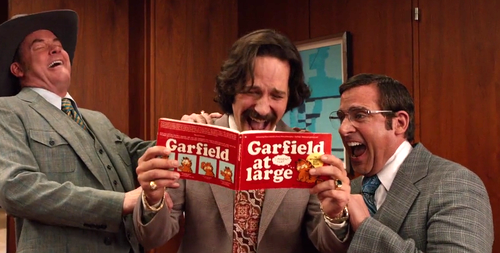
But besides the brilliant political satire, the film is just a great exercise in film comedy. Director Adam McKay's formula of improv dialogue, campy acting and ensemble scenes wins... mostly. I think this film suffers from too many celebrity cameos, a terribly unfunny child actor and not relying enough on the cast chemistry of the original. The original 4 comedians are electric together but they don't have many moments to shine. Steve Carrel has a bigger part as he became a bigger star in 9 years, but half of his screentime is dedicated to the less funny Kristine Wiig, who has since fizzled as a comic. Christina Applegate is mostly replaced by Meagan Good and its actually delightful, but then she returns in the duller 2nd half. Hollywood's pro-Hillary agenda is way too distracting here and the politics of star egos is palpable. Thankfully we are past Hillary and Paul Rudd (who is fabulous here) has become a star with a No 1 film to his name.
The only issue with an Anchorman 3 is setting it in an appropriate time span. Would it be set during the first George Bush era? I think that would be an unpopular masterstroke. Sure, no one under 30 remembers that era. Who cares? There's a lot of late 80s/1990s nostalgia and that was such a hilariously lame transition in pop culture. And yet its a rich moment in comedy history to highlight, analyze and lampoon. Caddyshack 2, anyone? SNL Season 10, anyone? "Donnie Darko" nailed that obscure but important time period beautifully so McKay and Ferrell can do it justice.
I can hear the cheesy Whitesnake soundtrack already.
The film underperformed and had cold reactions from fans of the original Anchorman and was ignored by the "serious film" snobs who failed to see the humor in it. While AM1 was an ironic W. Bush-era celebration of republican white male incompetency, younger audiences missed the joke and saw it a string of catchy one-liners that were paying liberal lip-service. AM2 rectifies this by being aggressively critical of "The Patriarchy". It doesn't play footsie with fratboys and is over giving homage to the lowbrow dad humor comedies of the 70s/80s. Where the first film held a loving mirror up to the dated liberalism of the Ford/Carter administrations, this sequel is a no-hold-barred reflection of Reagan Era racism, sexism, capitalism and cultural irresponsibility. Fans of Will Ferrell should be aware of this light/dark, safe/radical schism in his career sensibility. The 2 "Best of" SNL volumes for Farrell reflect this well.
I would love an Anchorman 3. It seems even more necessary than Part 2, which was a valiant defense of moderate liberalism and an overly gracious resistance to rightwing America's bigoted anti-Obama rhetoric. But we're dealing with a much worse threat now in Trump, who is the exact foot that this great comedy legacy was made to lampoon. An Anti-Trump Anchorman 3 would do be moral support for the entire country and depower the witless white nationalists trying to influence the mainstream. Oh, and it would probably make a fortune too.
But besides the brilliant political satire, the film is just a great exercise in film comedy. Director Adam McKay's formula of improv dialogue, campy acting and ensemble scenes wins... mostly. I think this film suffers from too many celebrity cameos, a terribly unfunny child actor and not relying enough on the cast chemistry of the original. The original 4 comedians are electric together but they don't have many moments to shine. Steve Carrel has a bigger part as he became a bigger star in 9 years, but half of his screentime is dedicated to the less funny Kristine Wiig, who has since fizzled as a comic. Christina Applegate is mostly replaced by Meagan Good and its actually delightful, but then she returns in the duller 2nd half. Hollywood's pro-Hillary agenda is way too distracting here and the politics of star egos is palpable. Thankfully we are past Hillary and Paul Rudd (who is fabulous here) has become a star with a No 1 film to his name.
The only issue with an Anchorman 3 is setting it in an appropriate time span. Would it be set during the first George Bush era? I think that would be an unpopular masterstroke. Sure, no one under 30 remembers that era. Who cares? There's a lot of late 80s/1990s nostalgia and that was such a hilariously lame transition in pop culture. And yet its a rich moment in comedy history to highlight, analyze and lampoon. Caddyshack 2, anyone? SNL Season 10, anyone? "Donnie Darko" nailed that obscure but important time period beautifully so McKay and Ferrell can do it justice.
I can hear the cheesy Whitesnake soundtrack already.
Wednesday, November 8, 2017
The Man With Two Brains 1983 / Cracking Up (aka Smorgasbord) 1983
Two very intellectual, avant garde comedies from the same year. Carl Reiner directs Steve Martin in "2 Brains" & Jerry Lewis directs himself in Smorgasbord (its original title by Jerry).
Now TMW2B is more commercial, more Americanized and less personal, but its still a far classier experience than most comedies since. I'd argue its better than most comedies that came before too. This is not the Reiner/Martin collaboration that gets the most props or notice, but its probably the most consistently funny. The plot is secondary but its not non-existent or throwaway. The film is a collection or selection of comedy skits all with the theme of modern romance. It has a detached coolness in its intimate portrayal of social suicides & defeating heartbreaks & magical rebirth.
Reiner was of course rivaling his ex-partner Mel Brooks at the time, so there's heat of critical gesturing and maybe loaded rejections of certain Brooks-style gimmicks. This is a pure Reiner madcap effort while Martin is at the top of his game as a performer & thinker. He trusts the humor and brings his own twists to much of Reiner's retro vaudeville. He plays it in a perfect slapstick tone so Reiner can build the rest of the film (Kathleen Turner, the plot, the music) as the "straight man". The film has a dreamy, sometimes queasy mixture of deadpan with the texture of absurdist realism. Its between a cartoon and a documentary.
I have to heavily recommend this to anyone. Its very welcoming, gentle and yet brilliantly enlightening.
Smorgasbord should be watched afterwards, when you have a wet palette for comic extremism. "Cracking Up" was a title studios slapped on it to appropriate it for "general" audiences. "Smorgasbord" is so much more fitting as the film is an almost plot-less collection of wide ranging dreams, fantasies, episodes and introspections from Jerry's well-established clown persona.
Its very low budget, feels European in production style and it actually plays to the European critics who were Lewis' biggest fans at the time. Lewis has some of the most fun of his career here as a humble aging master performer playing to his adoring crowd of philosophically astute and culturally accepting post-French New Wave. This might be Lewis' most auteurist work. Its filled with naked confessions, mature honesty, fiery snark & love for the craft of being a film comedian.
Lewis is one of the greatest screen comedians ever, if not the best. He utilized gags, reactions, one-liners, misdirection, staging, scope, color, timing, editing, emotion, etc. so simultaneously that it all felt effortless. And this is his purist effort. He's like a kid playing with cinematic toys. And he gives us all a fun, strange, gripping seat on a ride through a portrait of his mind. Excuse the word salad, but this film is that psychological, surreal and existentially profound. Yet it stays unpretentious and grounded in the spirit of a big kid having fun in the street with every other big kid.
Jerry famously taught a lot of people how to stay a big kid, but also how to remain an intellectual adult on the outside. In this film, Jerry apologizes for any negative reproach his fans might get, but assures them that they are the real geniuses for understanding his humor. This was the last feature film of Lewis' directorial career and its a wonderful swan song.
Now TMW2B is more commercial, more Americanized and less personal, but its still a far classier experience than most comedies since. I'd argue its better than most comedies that came before too. This is not the Reiner/Martin collaboration that gets the most props or notice, but its probably the most consistently funny. The plot is secondary but its not non-existent or throwaway. The film is a collection or selection of comedy skits all with the theme of modern romance. It has a detached coolness in its intimate portrayal of social suicides & defeating heartbreaks & magical rebirth.
Reiner was of course rivaling his ex-partner Mel Brooks at the time, so there's heat of critical gesturing and maybe loaded rejections of certain Brooks-style gimmicks. This is a pure Reiner madcap effort while Martin is at the top of his game as a performer & thinker. He trusts the humor and brings his own twists to much of Reiner's retro vaudeville. He plays it in a perfect slapstick tone so Reiner can build the rest of the film (Kathleen Turner, the plot, the music) as the "straight man". The film has a dreamy, sometimes queasy mixture of deadpan with the texture of absurdist realism. Its between a cartoon and a documentary.
I have to heavily recommend this to anyone. Its very welcoming, gentle and yet brilliantly enlightening.
Smorgasbord should be watched afterwards, when you have a wet palette for comic extremism. "Cracking Up" was a title studios slapped on it to appropriate it for "general" audiences. "Smorgasbord" is so much more fitting as the film is an almost plot-less collection of wide ranging dreams, fantasies, episodes and introspections from Jerry's well-established clown persona.
Its very low budget, feels European in production style and it actually plays to the European critics who were Lewis' biggest fans at the time. Lewis has some of the most fun of his career here as a humble aging master performer playing to his adoring crowd of philosophically astute and culturally accepting post-French New Wave. This might be Lewis' most auteurist work. Its filled with naked confessions, mature honesty, fiery snark & love for the craft of being a film comedian.
Lewis is one of the greatest screen comedians ever, if not the best. He utilized gags, reactions, one-liners, misdirection, staging, scope, color, timing, editing, emotion, etc. so simultaneously that it all felt effortless. And this is his purist effort. He's like a kid playing with cinematic toys. And he gives us all a fun, strange, gripping seat on a ride through a portrait of his mind. Excuse the word salad, but this film is that psychological, surreal and existentially profound. Yet it stays unpretentious and grounded in the spirit of a big kid having fun in the street with every other big kid.
Jerry famously taught a lot of people how to stay a big kid, but also how to remain an intellectual adult on the outside. In this film, Jerry apologizes for any negative reproach his fans might get, but assures them that they are the real geniuses for understanding his humor. This was the last feature film of Lewis' directorial career and its a wonderful swan song.
Thursday, October 26, 2017
Monty Python's The Meaning of Life 1983
Paid this old fave a visit. 2017 has been dry on comedy, certainly anything as broad as this. And over the years I've come to accept that this final work by the Pythons was a bit flawed and undercooked, but its still a fine culmination and final bow by all of the members.
Whats impressive is how the boys followed diverse paths after their success but still found common ground. Each skit feels like a philosophical argument of wits but tied together by a common mantra, finally revealed in their last written scene together.
The unity is tense.
The whole thing has a sad finality to it. It must've been the reflecting on mortality and their showing age, but the spirit of the film is a farewell to fans. A bit of the writing is clunky but each member stretches more than they ever did. Its refreshing to see a film without any phoned in performances. I think some wanted this to be their magnum opus and others saw it as another check before another check. So there's a mix of seriousness with frivolity, which harms the consistency of the humor but also keeps it from becoming too much "Brian" or "Grail". This is a great summary of both hemispheres of their combined brain.
Skit by skit is the only way to cover the action.
Whats impressive is how the boys followed diverse paths after their success but still found common ground. Each skit feels like a philosophical argument of wits but tied together by a common mantra, finally revealed in their last written scene together.
The unity is tense.
- Eric Idle is of course interested in building a musical comedy franchise from the Python gimmick (and he would eventually succeed!)
- Terry Jones is trying to lend the film as much cinematic credibility as possible
- Terry Gilliam wants to keep it as absurd and infantile as can be
- John Cleese has an inner struggle to not be the scene-stealing ham he loves being
- Michael Palin just wants to be as funny as everyone else and keep them all friends
- and Graham Chapman is channeling the last of his rage against the WASPy machine as he can in what would be the final years of his life
The whole thing has a sad finality to it. It must've been the reflecting on mortality and their showing age, but the spirit of the film is a farewell to fans. A bit of the writing is clunky but each member stretches more than they ever did. Its refreshing to see a film without any phoned in performances. I think some wanted this to be their magnum opus and others saw it as another check before another check. So there's a mix of seriousness with frivolity, which harms the consistency of the humor but also keeps it from becoming too much "Brian" or "Grail". This is a great summary of both hemispheres of their combined brain.
Skit by skit is the only way to cover the action.
- The Crimson Permanent Assurance - A great opening. It ties in thematically with everything to come while remaining Gilliam's personal statement. Shows just how sympatico the whole team was when the most individualistic & unique member is echoing the sentiments of 5 others.
- Miracle of Birth Pt 1 - This is light lifting for John & Graham, but its spot-on. Philosophical, juvenile, mean, sympathetic, pissed off and hilarious. And of course a bit metaphysically romantic and heartbreaking. Its a great closer to John & Graham's troubled but true bromance.
- Miracle of Birth Pt 2 - Finally, Michael & Jonesy outdo John & Graham head-to-head with the thanks of Eric and Graham himself. Its pretty risky to take on Catholicism with such snarling jokes, but thats what they do best. Visually, this is probably the best part of the film and the succession of pointed, brilliant jokes gives ya goosebumps.
- Growth & Learning - Probably my favorite writing in the whole film. John Cleese fires on all cylinders and you just stew in how brutally witty this guy is at dismantling religion, sex, nationality and any social construct he can work into a skit about ejaculation.
- Fighting Each Other - 3-part skit that brings down the humor and action. My least favorite? The beginning and ending are kinda painfully predictable and dated topically, but the African skit is really some of the BEST stuff to involve multiple Pythons. Because its them doing what they do best: making fun of British history. The subtle deadpan from John, Eric & Graham is exquisite master class stuff.
- The Middle of the Film - Perfect. This was probably the most insane scene to play in theaters in the 1980s.
- Middle Age - Kinda dry and dumb but has a few good lines and Eric is fabulous as a woman for the 2nd of 3 times.
- Live Organ Transplants - John, Graham & Gilliam being weird, brutal and darkly satirical. This seems like a deleted scene from "Brazil". Doesn't fit but... it fits because the whole joke is that this has nothing to do with anything. But it does summarize middle age I fear.
- The Autumn Years - Despite John & Jonesy having the most trying friendship in the group, they play off each other so beautifully. They might have the best chemistry in the entire film. And this is the ultimate example of their extreme "Mutt & Jeff" S&M chess game. This is the most dazzling bit of comic directing and vaudeville acting in the whole film. And the way other members (even, Carol Cleveland) are incorporated is superb. Eric's epilogue is wonderful too.
- Death - 3 part sketch, all dazzling. Poetic, gorgeous black comedy. Each scene really is a tearjerker and gave me gooseflesh. There's so much closure in their collective career playing out and it mirrors the strange downfall of the 20th century and the end of the film itself. Its their most meta of meta moments and a PERFECT final sketch.
- The End of the Film - Cherry on top that ties 30 years of stupidity and genius back to their very first sketch on TV. You couldn't plan a better finale for a comedy troupe. It had to have been an intuitive choice that just happened to work.
Thursday, May 11, 2017
Brain Candy 1996
Finally checked out the sole movie from Canada's biggest comedy troupe The Kids In The Hall after growing up a fan of their sketch show. Seems like this was both a box office grab from their producer and SNL mastermind Lorne Michaels and a bittersweet kiss-off from the boys. Brain Candy has the same production style and budget as It's Pat and Wayne's World and The Coneheads movie, but its way more ambitious and un-commercial (which says a lot as Its' Pat and Coneheads are fairly weird). Brain Candy feels more punk rock in sentiment and I think its a much more successful film artistically than the others. Its a ripe Fuck You to everyone, including Lorne Michaels.
The plot concerns a pharmaceutical scientist who develops a wonder drug that cures depression but goes to internal and external war with his boss, a now-obvious parody of Lorne Michaels. Its very interesting that this Michaels satire had to have been a spiky in-joke because it was Austin Powers that actually made Lorne Michaels' mannerisms and cold persona so famous. The villain here sounds, looks and acts like Michaels. I assume the troupe blamed Michaels for maybe softening their comedy near the end of the TV run as the major themes in Brain Candy are selling out, commercialization, conformity, easy riches, etc.
The film is reminiscent of Wayne's World superficially as its a simple small good guy vs a powerful bad guy with a backdrop of middle class stereotypes for laughs. At the same time, this baroque Ayn Rand-ian Romantic drama mythos was evident in the Kids' work for some time previously. Maybe Wayne's World borrowed ideas from Brain Candy and this is why the Kids are so pissed here. Whatever the reason, the bitterness fuels some awesome ideas and the film is really a buried classic; one of the finest film moments in the comedy genre from that period.
Its absurd, gross, sexy, sweet, bizarre, brilliant, sophomoric and hilarious as the gang was on TV. The boys made a fine leap to film so its a shame that they didn't do more together. This is more Monty Python's Meaning of Life than Bob and David's Run Ronnie Run, though its a fair mix of both dissimilar qualities. Those uninitiated with the KITH will have no trouble starting here and longtime fans of the Kids will get everything they could want, though curiously Dave Foley is barely in this film. Thankfully, the troupe's most underused and underrated Kevin McDonald takes center stage for most of the movie, which is a sweet touch showing the group still had a lot of love and respect flowing for one another, if no one else.
The plot concerns a pharmaceutical scientist who develops a wonder drug that cures depression but goes to internal and external war with his boss, a now-obvious parody of Lorne Michaels. Its very interesting that this Michaels satire had to have been a spiky in-joke because it was Austin Powers that actually made Lorne Michaels' mannerisms and cold persona so famous. The villain here sounds, looks and acts like Michaels. I assume the troupe blamed Michaels for maybe softening their comedy near the end of the TV run as the major themes in Brain Candy are selling out, commercialization, conformity, easy riches, etc.
The film is reminiscent of Wayne's World superficially as its a simple small good guy vs a powerful bad guy with a backdrop of middle class stereotypes for laughs. At the same time, this baroque Ayn Rand-ian Romantic drama mythos was evident in the Kids' work for some time previously. Maybe Wayne's World borrowed ideas from Brain Candy and this is why the Kids are so pissed here. Whatever the reason, the bitterness fuels some awesome ideas and the film is really a buried classic; one of the finest film moments in the comedy genre from that period.
Its absurd, gross, sexy, sweet, bizarre, brilliant, sophomoric and hilarious as the gang was on TV. The boys made a fine leap to film so its a shame that they didn't do more together. This is more Monty Python's Meaning of Life than Bob and David's Run Ronnie Run, though its a fair mix of both dissimilar qualities. Those uninitiated with the KITH will have no trouble starting here and longtime fans of the Kids will get everything they could want, though curiously Dave Foley is barely in this film. Thankfully, the troupe's most underused and underrated Kevin McDonald takes center stage for most of the movie, which is a sweet touch showing the group still had a lot of love and respect flowing for one another, if no one else.
Thursday, May 4, 2017
Funny Farm 1988
ChevyChase tried his hand at producing with the very underrated screwball comedy "Funny Farm". Its not the best Chase vehicle but maybe his most personal. It operates at his leisurely pace and is full of the romance, slapstick, cleverness and scenic beauty that is found in his best roles (Caddyshack, Vacation). Chase was a tremendous talent who needed particulars to do his best work. The producer's role had to make things much easier for him as an actor as he picked his director, writer and co-stars. But I can't decide if Funny Farm is an almost-classic or a true hidden gem.
Its certainly better than the great but uneven films Nothing But Trouble and Spies Like Us, but does it compare to Fletch or at least Fletch Lives? I prefer it to those actually. Chase is typecast as a lazy, snarky wiseass with a hard-on and lots of dated 80s dad coolness and, while he's excellent at it, I don't know if that was what Chase ever intended. Funny Farm shows Chase in a more realistic, Everyman role. He's very imperfect but never a buffoon or a prick. With a scaled back character, Chase's charm is more warm and his very muted emotionalism is very endearing. This may be his most fleshed out character. He played darker and more sympathetic characters, but this feels like someone you can more easily root for.
Its a simple premise: Chase and his wife (played by the gorgeous and quite subtle Madolyn Smith) move from the city to the country and things don't go as planned. Chase's fans probably expected a really juvenile movie and Chase gives them a few treats, but this is much closer to the sentimentality and family-friendliness of Christmas Vacation than his other films. Totally in-step with the John Hughes comedies of the period, but more sophisticated and less trendy which allows the film to hold up better. The film is full of great character actors and Madolyn Smith is one of the actresses you wish had a bigger career before stepping away from acting. Statuesque and as deadpan as Chevy, he never had a better companion in his romantic roles.
There isn't much more to say as its a fairly soft plot (but not dumb or loose) and it all sails on the execution of the perfectly assembled production. A few laughs could've been bigger than they are and maybe you will miss Chase's one-liners and little boy antics, but I think it stands on its own as a great moment in his career. It helps contextualize Chevy Chase as the Will Ferrell of his day, the coolest SNL hero of his day turned Hollywood leading man who is best remembered for zany sophomoric comedies and some warm-hearted family flicks but had a riskier side that made the occasional mature satire for his artsier fans.
Its certainly better than the great but uneven films Nothing But Trouble and Spies Like Us, but does it compare to Fletch or at least Fletch Lives? I prefer it to those actually. Chase is typecast as a lazy, snarky wiseass with a hard-on and lots of dated 80s dad coolness and, while he's excellent at it, I don't know if that was what Chase ever intended. Funny Farm shows Chase in a more realistic, Everyman role. He's very imperfect but never a buffoon or a prick. With a scaled back character, Chase's charm is more warm and his very muted emotionalism is very endearing. This may be his most fleshed out character. He played darker and more sympathetic characters, but this feels like someone you can more easily root for.
Its a simple premise: Chase and his wife (played by the gorgeous and quite subtle Madolyn Smith) move from the city to the country and things don't go as planned. Chase's fans probably expected a really juvenile movie and Chase gives them a few treats, but this is much closer to the sentimentality and family-friendliness of Christmas Vacation than his other films. Totally in-step with the John Hughes comedies of the period, but more sophisticated and less trendy which allows the film to hold up better. The film is full of great character actors and Madolyn Smith is one of the actresses you wish had a bigger career before stepping away from acting. Statuesque and as deadpan as Chevy, he never had a better companion in his romantic roles.
There isn't much more to say as its a fairly soft plot (but not dumb or loose) and it all sails on the execution of the perfectly assembled production. A few laughs could've been bigger than they are and maybe you will miss Chase's one-liners and little boy antics, but I think it stands on its own as a great moment in his career. It helps contextualize Chevy Chase as the Will Ferrell of his day, the coolest SNL hero of his day turned Hollywood leading man who is best remembered for zany sophomoric comedies and some warm-hearted family flicks but had a riskier side that made the occasional mature satire for his artsier fans.
Wednesday, May 3, 2017
Nothing But Trouble 1991
In my review of Big Trouble In Little China, I talked about a connection to Texas Chainsaw Massacre 2. Here are two films from the dawn of the post-Spielberg/Lucas multiplex era of Hollywood, both made by 70s genre madmen and both made completely surreal by their sloppiness, bloated budgets and a zaniness that is perceived to be a post-Reagan cocaine mania. Let me complete the trilogy by adding Dan Aykroyd's 1991 horror-satire "Nothing But Trouble" to create a very bizarre marathon of films that closed the generational revolution in 1970s/1980s mainstream cinema.
Big Trouble and Chainsaw 2 have become loudly embraced online by cult film enthusiasts, but not so for Nothing But Trouble. Reasons being those previous films are closely associated 1980s adolescence, they both belong to very film nerd-friendly genres and were directed by very popular cult directors. We're still waiting for a re-appreciation of Bush Era cinema, mainstream comedy bombs by SNL alum and no one really examines Dan Aykroyd's one-off directing job because Aykroyd is mostly obscure to young people outside of Ghostbusters, Tommy Boy and maybe My Girl.
Which is a shame because Dan Aykroyd is the most enigmatic, cerebral and undervalued of the first generation of SNL stars. Frankly, he had the strongest career in the 1990s as Chevy Chase and Bill Murray's stars were fading fast. He branched out into broader roles in Driving Miss Daisy and carried a very ambitious film version of The Coneheads (what could be argued as the best SNL film adaptation against Wayne's World). But as Bill Murray reinvented himself in Wes Anderson movies and Chevy Chase gained a fratboy cult thanks to Fletch reruns, Aykroyd all but retired to focus on UFOS, vodka and Hard Rock Cafe. After Blues Brothers 2000, many comedy fans forgot how valuable Aykroyd was to his generation.
Nothing But Trouble is the best film evidence of Ayroyd's immense talent and uniqueness. It seems like a a last Fuck You from a maturing rebel who has one chance at sharing his vision. Dan Aykroyd had a good career in the 1980s, but never captured the fire, weight and popularity he had on SNL. Chase and Murray became cool anti-authoritarian clowns who carried blockbusters but Aykroyd was usually cast as the sidekick or straight man, typically to his SNL or Second City friends. And he was great at it. The Great Outdoors, Spies Like Us, Dragnet, Neighbors, Caddyshack 2. He was also the only star to write the scripts he performed (as he did on SNL). Maybe the nice guy who always finished last needed to rack up enough good merit and favors because Nothing But Trouble is a very surprising directorial debut in every conceivable way.
First off its produced by Warner Bros with a titanic production, a totally un-commercial script and an HUGE star in Demi Moore. For the unitiated, this film contains: giant obese men in diapers, a carnival ride that removes flesh from living human beings, John Candy as a woman, a penis nose, a removed nose, bed pan humor and a lengthy rap performance featuring a teenage 2Pac. Even at its most grotesque or subversive, its all presented in a cartoon fashion. Its very similar to TCM2 in what it satirizes - conservative politics, yuppies, older men/younger women dynamics, dysfunctional families, rednecks, drug abuse, law enforcement, mental illness, greed and the American value system. I wouldn't be shocked if Dan was a big TCM2 fan or friend of Tobe Hooper. And the film is very reminiscent of Big Trouble in that its a schizophrenic mishmash of wildly different genres, this time being The Goonies, screwball Cary Grant comedies, John Waters shock comedies and rural horror movies like Spider Baby. Like TCM2 and BTILC, NBT doesn't really work. Its derivative, half-baked and poorly edited, but you can tell a lot of passion went into this and a lot of fun was had making this. The "What the fuck am I watching?" factor is high and the very game actors had to 2nd guess the material and then fully commit to the fun and weirdness and it pays off.
But Dan Aykroyd carries the entire film with his performance as the disgusting but charming antagonist. He's covered in prosthetics in TWO roles and its obvious he wanted to play every role in the film. The other characters are really after thoughts to tie scenes together and are actually underutilized. When it finally takes off, NBT is a string of Aykroyd skits that really echo his best SNL work, unlike everything else in his film career. This is the awkward, confrontational, bizarre, grotesque, outsider comedy that made him standout from the pack as the friendliest weirdo and a kind of comic chameleon. The movie is padded with very sophomoric, self-indulgent slapstick and Aykroyd's patented surreal lingustic showboating, but how its tied together in something resembling a meaningful whole is impressive. Its light, inoffensive and totally surprising cinema. Some may not get it or even like it, but who could hate it?
BTW Chevy Chase still had a big name and looks pretty fantastic here, so its a coup that he signed on but its no surprise. Chase seems to be Aykroyd's life partner even if Belushi was his one true love and Bill Murray his most successful romance. They worked together on Spies Like Us, Caddyshack 2 and Aykroyd was one of Chase's biggest supporters in the tumultuous first 5 years of SNL. NBT offers Chevy one if not his last leading man roles (as did John Carpenter's Memoirs of an Invisible Man - another Big Trouble connection). Wikipedia has this to say:
According to one biography, Chase "knew that the film was going to be the worst film he would ever make", but because of his friendship with Aykroyd, he accepted the role of Chris Thorne.[4] Reflecting on the film some years later, it was noted as an "unfortunate turning point" in Aykroyd's career that, as the director, writer and star, left "only (Aykroyd) to blame for the film's spectacular failure".[5]
Unfortunate that it probably ended their partnership and probably hurt their friendship. I would be very interested in seeing where Aykroyd's directing went next and I think its a gem in both of their careers. Nothing But Trouble probably ended both of their careers as Hollywood players, but it shows Chase wasn't always a selfish diva and that Aykroyd never lost his edge. I wonder if they realize this legendary bomb has become, at least in my family, a very beloved little film. I hope fan support grows for it and Aykroyd and Chase can make peace with it.
Big Trouble and Chainsaw 2 have become loudly embraced online by cult film enthusiasts, but not so for Nothing But Trouble. Reasons being those previous films are closely associated 1980s adolescence, they both belong to very film nerd-friendly genres and were directed by very popular cult directors. We're still waiting for a re-appreciation of Bush Era cinema, mainstream comedy bombs by SNL alum and no one really examines Dan Aykroyd's one-off directing job because Aykroyd is mostly obscure to young people outside of Ghostbusters, Tommy Boy and maybe My Girl.
Which is a shame because Dan Aykroyd is the most enigmatic, cerebral and undervalued of the first generation of SNL stars. Frankly, he had the strongest career in the 1990s as Chevy Chase and Bill Murray's stars were fading fast. He branched out into broader roles in Driving Miss Daisy and carried a very ambitious film version of The Coneheads (what could be argued as the best SNL film adaptation against Wayne's World). But as Bill Murray reinvented himself in Wes Anderson movies and Chevy Chase gained a fratboy cult thanks to Fletch reruns, Aykroyd all but retired to focus on UFOS, vodka and Hard Rock Cafe. After Blues Brothers 2000, many comedy fans forgot how valuable Aykroyd was to his generation.
Nothing But Trouble is the best film evidence of Ayroyd's immense talent and uniqueness. It seems like a a last Fuck You from a maturing rebel who has one chance at sharing his vision. Dan Aykroyd had a good career in the 1980s, but never captured the fire, weight and popularity he had on SNL. Chase and Murray became cool anti-authoritarian clowns who carried blockbusters but Aykroyd was usually cast as the sidekick or straight man, typically to his SNL or Second City friends. And he was great at it. The Great Outdoors, Spies Like Us, Dragnet, Neighbors, Caddyshack 2. He was also the only star to write the scripts he performed (as he did on SNL). Maybe the nice guy who always finished last needed to rack up enough good merit and favors because Nothing But Trouble is a very surprising directorial debut in every conceivable way.
First off its produced by Warner Bros with a titanic production, a totally un-commercial script and an HUGE star in Demi Moore. For the unitiated, this film contains: giant obese men in diapers, a carnival ride that removes flesh from living human beings, John Candy as a woman, a penis nose, a removed nose, bed pan humor and a lengthy rap performance featuring a teenage 2Pac. Even at its most grotesque or subversive, its all presented in a cartoon fashion. Its very similar to TCM2 in what it satirizes - conservative politics, yuppies, older men/younger women dynamics, dysfunctional families, rednecks, drug abuse, law enforcement, mental illness, greed and the American value system. I wouldn't be shocked if Dan was a big TCM2 fan or friend of Tobe Hooper. And the film is very reminiscent of Big Trouble in that its a schizophrenic mishmash of wildly different genres, this time being The Goonies, screwball Cary Grant comedies, John Waters shock comedies and rural horror movies like Spider Baby. Like TCM2 and BTILC, NBT doesn't really work. Its derivative, half-baked and poorly edited, but you can tell a lot of passion went into this and a lot of fun was had making this. The "What the fuck am I watching?" factor is high and the very game actors had to 2nd guess the material and then fully commit to the fun and weirdness and it pays off.
But Dan Aykroyd carries the entire film with his performance as the disgusting but charming antagonist. He's covered in prosthetics in TWO roles and its obvious he wanted to play every role in the film. The other characters are really after thoughts to tie scenes together and are actually underutilized. When it finally takes off, NBT is a string of Aykroyd skits that really echo his best SNL work, unlike everything else in his film career. This is the awkward, confrontational, bizarre, grotesque, outsider comedy that made him standout from the pack as the friendliest weirdo and a kind of comic chameleon. The movie is padded with very sophomoric, self-indulgent slapstick and Aykroyd's patented surreal lingustic showboating, but how its tied together in something resembling a meaningful whole is impressive. Its light, inoffensive and totally surprising cinema. Some may not get it or even like it, but who could hate it?
BTW Chevy Chase still had a big name and looks pretty fantastic here, so its a coup that he signed on but its no surprise. Chase seems to be Aykroyd's life partner even if Belushi was his one true love and Bill Murray his most successful romance. They worked together on Spies Like Us, Caddyshack 2 and Aykroyd was one of Chase's biggest supporters in the tumultuous first 5 years of SNL. NBT offers Chevy one if not his last leading man roles (as did John Carpenter's Memoirs of an Invisible Man - another Big Trouble connection). Wikipedia has this to say:
According to one biography, Chase "knew that the film was going to be the worst film he would ever make", but because of his friendship with Aykroyd, he accepted the role of Chris Thorne.[4] Reflecting on the film some years later, it was noted as an "unfortunate turning point" in Aykroyd's career that, as the director, writer and star, left "only (Aykroyd) to blame for the film's spectacular failure".[5]
Unfortunate that it probably ended their partnership and probably hurt their friendship. I would be very interested in seeing where Aykroyd's directing went next and I think its a gem in both of their careers. Nothing But Trouble probably ended both of their careers as Hollywood players, but it shows Chase wasn't always a selfish diva and that Aykroyd never lost his edge. I wonder if they realize this legendary bomb has become, at least in my family, a very beloved little film. I hope fan support grows for it and Aykroyd and Chase can make peace with it.
Subscribe to:
Comments (Atom)