11 Jess Franco reviews for you, bitch... Franco-mania!
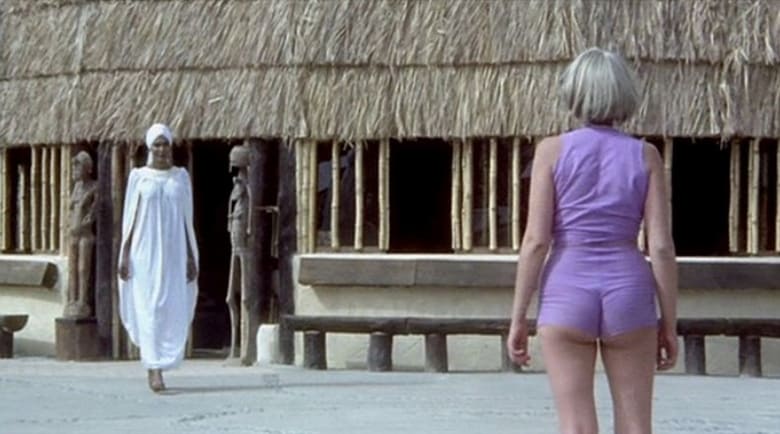
Macumba Sexual is an almost masterpiece. Franco remakes "Vampyros Lesbos" with a transgender theme! Replacing the irreplaceable Soledad Miranda is the commanding Ajita Wilson, the most beautiful black she-male in cinema history. She's seducing Lina Romay (as her blonde actress title "Candy Coaster") to take her role as some pan-sexual goddess of lust. The plot is low on incident and keeps to maybe 3 locations, all around a hotel. Its a breathtaking experience despite this, gorgeous and alive with subversive sexual metaphors. Throughout the film, Lina is haunted by physical objects
that are both masculine and feminine at the same time while Franco never hides the fact that Ajita is transgender. He attacks the gender binary and really scrambles what an erotic horror film can be. For him this is an exploitative ride to attack homophobia and sexual insecurity. I don't know if its respectful to trans people, but I think its firmly on their side and is the most brave, entertaining and early examples of the subject in cinema.
Voodoo Passion is likewise a minor classic. Playing similarly to both "Virgin Among the Living Dead" and the formula of "Succubus" and "Nightmares Come at Night", I think Voodoo Passion plays better than all three. It has an impressive production, flawless cinematography, a beautiful score, truly erotic sex scenes, a game cast and some fabulous direction. It also irons out some flaws in the highly disjointed narratives of those previous films. You could only dock it points for being predictable, but Jess provides enough twists visually and narratively that you can call this a successful jazz variation.
Revenge/Usher is "final level Franco". You can't appreciate this until you know his oeuvre, biography and financial limitations. I would call it something of a no-budget masterpiece if Eurocine producers didn't poorly edit it into the kitsch it is today. Franco shot a fairly personalized but tonally correct version of Poe's classic with no budget. Had Jess had a few dollars more, it would be comparable to his Dracula. But Eurocine didn't like it, added 10 minutes of footage from Dr Orloff(!) and then added poorly done inserts to try and smooth it out. They did the same to "Virgin" apparently. If you know the story behind this film, its quite an eye-opener and an amazing demonstration of Franco's genius, but this is NOT for casual fans or horror fans.
Devil Hunter is a solid Eurotrash ride. Its a camp spoof of racist cannibal films made in Italy at the time and it still works as an anti-racist horror film. Franco shows great kindness for black people in his films, especially primitive tribes. This film paints the white characters as just as barbaric and maybe twice as depraved. Like the transgressive bits of transgenderism in Macumba, Franco displays his radicalism not in preachy dialogue, righteous characters or obvious gestures. He uses the power of ironic montage, contrast, dialectical materialism that he learned as a young admirer of Eisenstein. Devil Hunter is surprisingly long and quite absurdist, but its an epic enjoyment for his fans or anyone who is in on the joke. Also, just remember that the bug-eyed native is essentially "Morpho". This will make sense later...
Death/Blues is a small political thriller from Franco's early film period. Its gorgeous, well-paced and extremely heavy on dialogue. While its a refreshing break from many films of its time, it lacks the unique style that Franco would patent later. But it still has his hallmarks: anti-racism, proletariat sympathies, revenge, a sexy tropical atmosphere and a good soundtrack. Its evidence of Franco's ability to handle your regular commercial film but such a solid B&W caper is a footnote to his career and thats a compliment. I still recommend it for the time capsule appeal and the biographical nature of the story.
Mondo Cannibal is known as a piece of shit, but it has its moments. Its hated by fans of the cannibal genre because its low on gore, cannibals and action. But the plot is quite good and would be resurrected for "Diamonds...". This film is a bit of a chore because its maybe Franco's slowest and least artistic film, but it has (shockingly) some of the best photography of this period and the real sell is Sabrina Siani, who is inhumanly attractive and naked throughout the film. I wish this film was as progressive as the other Franco jungle films, but its no big loss because all of the natives are played by Italians! Actually, I suspect that was a joke and that the film is lampooning Italians taste for gore and their rampant anti-black racism. I've heard Franco diss Italian directors for their desire to be seen as white/American and this film is his rejection of the Italian schlock directors he is still lumped in with. In retrospect, this film was an intentionally "bad" anti-gore film.
How to Seduce a Virgin is a not-as-strong remake of the exquisite Eugenie, but it has its areas of supremacy. The sexual content here is excellent, the cast is different but equal, the production is smaller but more moody. This is kind of a dark X-rated doppelganger of a classic. There are some plot tweaks and maybe the best substitution is Lina Romay as the helpless minion. This might be her best role, likewise the underrated Alice Arno.
Mansion/Living Dead is basically a re-do of Bloody Moon, but serving Franco's sensibilities. We have some sexy Spanish girls at a hotel with a slasher. I still prefer Moon, but Mansion is close in quality. It leans towards a smaller, more absurd plot and a more hypnotic, dreamy style of directing. What Mansion does have is better dialogue, sexier lesbian action and a phenomenal female gimp character who steals the entire film each time she arrives. This film becomes a personal account of Franco's relationship with Lina and his own guilt in keeping this much younger, wilder woman to himself, a rather bookish man of small means. Many films from this period revolve around their real world romantic dynamic, its up's and down's and sadomasochism. Lina is more than a muse in these films. She's a strong actress with the unique gift of having a film told through her and about her.
Fall of the Eagles is the cheapest Franco film I've ever seen. It literally a couple really well-directed scenes about a Nazi love triangle before, during and after WW2 with some stock footage linking it together. The performances are strong from Christopher Lee and Mark Hamill (TWO fucking Jedi's directed by the guy who helped inspire Yoda!!!!) while Joe Estavez's son gives what might be the worst acting performance ever. The entire film is so uneven yet so watchable, a perfect time waster. Considering it cost nothing, I didn't feel cheated. It reminds me of the much worse Full Moon films that obsessively use WW2 as a backdrop. Despite its many limitations, Eagles IS a very serious, crafted and poignant story.
Dr Orloff's Monster is a well-made little thriller, way more conservative than its radical predecessor, but it introduces some important tropes into the Franco canon: adultery turning to murder (But Who Raped Linda?) and a young girl inheriting a dark castle of evil secrets (Virgin..., Daughter of Dracula). The plot and style of this film provides the gist of the much more entertaining Erotic Rites of Frankenstein, but you won't be disappointed in the noir-esque photography and what was once groundbreaking treatment of sex and violence. But its no match for...
The Awful Dr. Orloff. Finally I review the one that made Jess Franco a famous international genre director. I've watched it before but its much better with more context of what it spawned. Its been written that Orloff is a rip-off of Eyes Without a Face. Franco denies it and I believe him as The Brain That Wouldn't Die is also ridiculously similar to these two films. I think we have a case of 3 people thinking the same thing at once: surgical horror. They all were deconstructing Gothic horror films and predicting the rise of abused plastic surgery. Eyes is the classiest of the 3, Brain the most vulgar and Franco's little film is a perfect blend of both. Its evident how much the suggestive dialogue and rape-themed violence was in such a Catholic, conservative culture. And this is really the most expressionist and epic film of Franco's career. Its just a finely directed old school horror film that no one can fault. But Francophiles will take sweet pleasure in how personal the film reveals itself to be all these years later.
We witness the birth of Franco's most personal and repeated plot device: The Master and Slave. Dr Orloff (who would return so many times) is a mad surgeon based on Jess' army doctor father and in extension the Generalissimo Franco. He's an affluent, cruel, bourgeois monster, but physically and emotionally human in every way. Early on its revealed that his deep seated obsession with female flesh comes from his own insecurity about control, aging and dying. This rings as a confession of Jess' later lustful work as Orloff's violence is carried out by his demeaned bug-eyed relative, "Morpho". This is an obvious placeholder for Jess and Jess would even play the Morpho role in following films. Is Franco's entire filmography as actor/director his working through a tyrannical Father complex? Definitely.
This film has a solid climax but the rather hollow Dr Orloff's Monster might be even more personal as that film ends with the Morpho monster actually striking down the evil father character. Now read into Orloff killing women to preserve the image of his own daughter? (Or sister in "Faceless") The maternal side of Franco's anxieties would be explored in Jack the Ripper, sibling & daughter incest would pop up later. Having a Mexican father and Cuban mother, I suspect Jess' mother was dark-skinned, explaining his fetish for light skin but his distanced but bleeding heart for darker skinned women. Its so obvious why he found special balance in Soledad Miranda and then Lina Romay. The strange abusive childhood Jess had with some 8 siblings in a fascist militaristic surgeon's home spawned a lifetime of traumatic confessions on celluloid and video. The racial tension between his parents and the mixed heritage in Latin communities also left a huge impact on the little Jesus, turning him to jazz, political radicalism and becoming a malcontent who purposely deprived his genius from popularity.
I hope this sad but beautiful little genius is at peace now and that this amazing body of work will live on forever and become more legendary than it already is.
Showing posts with label 1962. Show all posts
Monday, February 12, 2018
Macumba Sexual 1983 / Voodoo Passion 1977 / Revenge in the House of Usher 1983 / Devil Hunter 1980 / Death Whistles to the Blues 1964 / Mondo Cannibal 1980 / How Seduce a Virgin 1974 / Mansion of the Living Dead 1982 / Fall of the Eagles 1989 / Dr. Orloff's Monster 1964 / The Awful Dr. Orloff 1962
Tuesday, December 12, 2017
Alien vs Predator 2004 / Liebestraum 1991 / The World's Greatest Sinner 1962 / Ichi The Killer - The Animation 2002
Alien Vs Predator impressed me. I expected something way more militaristic, rightwing, white sausage fest, but actually got a thoughtful, shadowy, ambitious and well-integrated adaptation of a classic cross-franchise comic book. It also succeeds as semi-sequels to both of the franchises' films which is transcendent. Seriously, the entire film is luxuriously paced, intricately lit and directed with some real modesty and sweetness. So much of this is the perfect casting of Sanaa Lathan who while representing a new kind of racial representation in not just this genre but ALL GENRES, she fits the type expertly. She merges the dainty heroine presence of the 1950s actresses with a broader command of herself. The film has a few unintentional laughs (and many intentional ones) and I thought it was perhaps too much fluffy spectacle and not enough character, but this didn't receive the major push and care that Prometheus or even Alien Resurrection did. Yet... I think AVP is better than both of those sequels and I'm sure it trumps the new Predator movies.
The actual message of the film is hazy and so my opinion on it is still out. The film's mythology casts the warring alien races as related to South American & African tribal cultures. In ass backwards fashion, AVP tries to sell some kind of apology or meditation on the savagery of slavery and the monstrosity of the slavemasters... by letting the slavemasters win and driving home the perceived beast nature of the "lower" alien race. Its offensive to me as a black person, as an animal lover and as a universal consciousness. The film is written by the director Paul W.S. Anderson who brings his usual Gothic visual panache & by the original Alien screenwriter Dan O'Bannon (an early collaborator with Carpenter and directed Return of the Living Dead). This lends the film a detailed sci-fi logic and all of the popcorn cues desired and it is progressive and enlightened in many ways, but it is also a bit meat-headed, warped and a tad trashy. Sanaa Lathan is the best part and gets decent support and I will definitely watch this again, but its not a great movie. But still important to analyze and refer to.
Liebestraum came out in 1991 - the height of David Lynch mania - and you can tell. Its made in the mode of Twin Peaks meets 1989's Sex Lies and Videotape. Its a jazz meets industrial erotic thriller in a film noir vein (or "vain").
I found the film to be quite a relaxing and pleasant experience. Its engaging intellectually as a demonstration of Freudian constructs of sex, neurosis & dreams, totally in keeping with Lynch and Hitchcock. Director Mike Figgis even casts Kim Novak as the archetypal mother. The acting is measured and textured, the naturalistic lighting is fresh and the subtexts are emotional and important enough. Except for a few brief glimpses, the film doesn't bowl you over. I mean once the mystery is unraveled, will you rewatch it for the aesthetics and will the themes ring louder? Doubtful.
The film practices the Early Remodernism I think Amos Poe originally intended. Its beholden to pre-postmodernism, the art and social ideals of pre-WW2 western thought. Its embracing enough of black music and highly critical of capitalism, yet still annoyingly, dogmatically conservative and its "retro" is an overwhelmingly artificial stylistic choice that undercuts the drama, not building it. Modern American cinema is steeped in this kind of indie filmmaking - sexually frustrated, European cinema-mimicking, nostalgic infantilized ego trips. Hitchcock, De Palma and David Lynch have sort of mastered this ethos and deconstructed it, so the remaining films in this genre are really just boring and predictable now, but Liebestraum does deserve a concentrated watch for unconscious reasons.
Why you should really watch the film is the curious amount of ideas borrowed by Lynch in subsequent films. The look, the sound design, the cast, even direct story arcs are taken. Lynch has used Alicia Witt, would cast Pamela Gidley in FWWM and Bill Pullman in the almost-remake Lost Highway. It demystifies and lowers Lynch in my eyes as he goes out of his way to rarely reveal influences and I didn't know he was copying contemporaries. Lost Highway is Lynchian and a more powerful experience, but essentially its the same script and production design as Liebestraum. Noticeably its the most hip and unusual style Lynch has attempted and you have to now give that credit to Liebestraum.
Besides that historical revelation, it is a competent low budget art film for its time and it holds up extremely well to today's predictable and even more gratuitously derivative crime/pulp/thriller/mysteries on TV and in theaters. Again, its a little too impersonal, leisurely and basic (which Lost Highway improves on), but maybe more authentic because of these limitations. Its not regressive but definitely old fashioned.
Its been over-exaggerated by a tiny minority of film fans, but The World's Greatest Sinner is a unique and bold touchstone in the history of early American indie filmmaking. It was directed, produced and written by the eternally struggling brute-characterized actor Timothy Carey as a kind of angry, perverted, manic, egotistical study of itself.
Carey plays an insurance agent who drops out of society, forms an atheist rock band, renames himself "God", runs for office and then has a moral breakdown about his own Atheism and quest to free mankind from God. Its a blunter version of Kane's study of populists, fascists, egoists and Western society's tools to produce them. But this is a much more cartoon and ignorant version. It still holds up as a mirror to people like Donald Trump and Adolph Hitler, but this was designed to bash Jerry Lee Lewis and Hollywood hipsters and not reveal the artist's own apparent shortcomings.
Like Welles, Carey wanted to prove that he was more than the big dumb oafs he played. Now the film is not great technically or morally. Its flatly a conservative Christian "scare film" that is anti-black music, anti-communist, anti-atheist, anti-Satan and anti-JFK. Carey comes off like the 60s' Alex Jones: paranoid, ignorant, childish and really disturbed in his self-worship. So its poetic that that is what he's showcasing. In many ways you can compare it to the self-destructive ego on display in Citizen Kane, The Room or Dennis Hopper's films. These guys made personally revealing, audacious "art films" but ruined their careers in the process. Carey is on the bottom of the list but he's still an early example.
Ichi The Killer - The Animation Ep.0 was the best watch of the night. It breaks from the original film's medium, tone, structure and messages, yet it achieves the same effect by building subtext for the first story.
Now the original film is a darkly funny study of the psychotic, sadomasochistic relationship Japanese men have to white supremacy and thus to each other. This is the underlying point that is really only revealed in the climax and lightly woven between key instances of each scene of a massive, campy pulp plot. With that revelation already in the Japanese fans' minds, the anime focuses on a harder boiled story with an even more surrealistic "ordinary" reality within the original manga universe that inspired the films. And it can also shave off the ornament, the aesthetic and the censored.
This film is allowed to explore the more extreme and horrific suggestions made by the original Ichi.
And at the same time, because it is done in a vibrantly expressionistic "limited animation" style (almost the virtual experience of reading a manga), this film is allowed to work on a deeper dream level. Its so unreal that it can say scarier things about reality or "realism".
Overall, you will love this if you love the first Ichi film. Its a proper, respectful and separate part of the mythos that opens up the parameters of the original and cleverly opens up possibility of more parameters to seek and not just in cheap carbon copy sequels.
The actual message of the film is hazy and so my opinion on it is still out. The film's mythology casts the warring alien races as related to South American & African tribal cultures. In ass backwards fashion, AVP tries to sell some kind of apology or meditation on the savagery of slavery and the monstrosity of the slavemasters... by letting the slavemasters win and driving home the perceived beast nature of the "lower" alien race. Its offensive to me as a black person, as an animal lover and as a universal consciousness. The film is written by the director Paul W.S. Anderson who brings his usual Gothic visual panache & by the original Alien screenwriter Dan O'Bannon (an early collaborator with Carpenter and directed Return of the Living Dead). This lends the film a detailed sci-fi logic and all of the popcorn cues desired and it is progressive and enlightened in many ways, but it is also a bit meat-headed, warped and a tad trashy. Sanaa Lathan is the best part and gets decent support and I will definitely watch this again, but its not a great movie. But still important to analyze and refer to.
Liebestraum came out in 1991 - the height of David Lynch mania - and you can tell. Its made in the mode of Twin Peaks meets 1989's Sex Lies and Videotape. Its a jazz meets industrial erotic thriller in a film noir vein (or "vain").
I found the film to be quite a relaxing and pleasant experience. Its engaging intellectually as a demonstration of Freudian constructs of sex, neurosis & dreams, totally in keeping with Lynch and Hitchcock. Director Mike Figgis even casts Kim Novak as the archetypal mother. The acting is measured and textured, the naturalistic lighting is fresh and the subtexts are emotional and important enough. Except for a few brief glimpses, the film doesn't bowl you over. I mean once the mystery is unraveled, will you rewatch it for the aesthetics and will the themes ring louder? Doubtful.
The film practices the Early Remodernism I think Amos Poe originally intended. Its beholden to pre-postmodernism, the art and social ideals of pre-WW2 western thought. Its embracing enough of black music and highly critical of capitalism, yet still annoyingly, dogmatically conservative and its "retro" is an overwhelmingly artificial stylistic choice that undercuts the drama, not building it. Modern American cinema is steeped in this kind of indie filmmaking - sexually frustrated, European cinema-mimicking, nostalgic infantilized ego trips. Hitchcock, De Palma and David Lynch have sort of mastered this ethos and deconstructed it, so the remaining films in this genre are really just boring and predictable now, but Liebestraum does deserve a concentrated watch for unconscious reasons.
Why you should really watch the film is the curious amount of ideas borrowed by Lynch in subsequent films. The look, the sound design, the cast, even direct story arcs are taken. Lynch has used Alicia Witt, would cast Pamela Gidley in FWWM and Bill Pullman in the almost-remake Lost Highway. It demystifies and lowers Lynch in my eyes as he goes out of his way to rarely reveal influences and I didn't know he was copying contemporaries. Lost Highway is Lynchian and a more powerful experience, but essentially its the same script and production design as Liebestraum. Noticeably its the most hip and unusual style Lynch has attempted and you have to now give that credit to Liebestraum.
Besides that historical revelation, it is a competent low budget art film for its time and it holds up extremely well to today's predictable and even more gratuitously derivative crime/pulp/thriller/mysteries on TV and in theaters. Again, its a little too impersonal, leisurely and basic (which Lost Highway improves on), but maybe more authentic because of these limitations. Its not regressive but definitely old fashioned.
Its been over-exaggerated by a tiny minority of film fans, but The World's Greatest Sinner is a unique and bold touchstone in the history of early American indie filmmaking. It was directed, produced and written by the eternally struggling brute-characterized actor Timothy Carey as a kind of angry, perverted, manic, egotistical study of itself.
Carey plays an insurance agent who drops out of society, forms an atheist rock band, renames himself "God", runs for office and then has a moral breakdown about his own Atheism and quest to free mankind from God. Its a blunter version of Kane's study of populists, fascists, egoists and Western society's tools to produce them. But this is a much more cartoon and ignorant version. It still holds up as a mirror to people like Donald Trump and Adolph Hitler, but this was designed to bash Jerry Lee Lewis and Hollywood hipsters and not reveal the artist's own apparent shortcomings.
Like Welles, Carey wanted to prove that he was more than the big dumb oafs he played. Now the film is not great technically or morally. Its flatly a conservative Christian "scare film" that is anti-black music, anti-communist, anti-atheist, anti-Satan and anti-JFK. Carey comes off like the 60s' Alex Jones: paranoid, ignorant, childish and really disturbed in his self-worship. So its poetic that that is what he's showcasing. In many ways you can compare it to the self-destructive ego on display in Citizen Kane, The Room or Dennis Hopper's films. These guys made personally revealing, audacious "art films" but ruined their careers in the process. Carey is on the bottom of the list but he's still an early example.
Ichi The Killer - The Animation Ep.0 was the best watch of the night. It breaks from the original film's medium, tone, structure and messages, yet it achieves the same effect by building subtext for the first story.
Now the original film is a darkly funny study of the psychotic, sadomasochistic relationship Japanese men have to white supremacy and thus to each other. This is the underlying point that is really only revealed in the climax and lightly woven between key instances of each scene of a massive, campy pulp plot. With that revelation already in the Japanese fans' minds, the anime focuses on a harder boiled story with an even more surrealistic "ordinary" reality within the original manga universe that inspired the films. And it can also shave off the ornament, the aesthetic and the censored.
This film is allowed to explore the more extreme and horrific suggestions made by the original Ichi.
And at the same time, because it is done in a vibrantly expressionistic "limited animation" style (almost the virtual experience of reading a manga), this film is allowed to work on a deeper dream level. Its so unreal that it can say scarier things about reality or "realism".
Overall, you will love this if you love the first Ichi film. Its a proper, respectful and separate part of the mythos that opens up the parameters of the original and cleverly opens up possibility of more parameters to seek and not just in cheap carbon copy sequels.
Thursday, October 26, 2017
Carnival of Souls 1962
You could have a solid debate that "Carnival of Souls" is the first truly post-modern horror film, the most existentialist horror film & even the greatest horror film ever made.
Following in the wake of Antonioni's Neorealism in Italy, Godard's New Wave in France & Hitchcock's game-changer "Psycho" in 1960, a modest independent filmmaker Herb Harvey crafted a superb mixture of these and more ("Dr. Caligari" & Maya Deren for sure). Carnival of Souls is a lyrical, minimalist tone poem about the inescapable, universal journey we all must make in losing our life.
Candace Hilligoss plays a woman who is going mad as it dawns on her that her life is over. She is a ghost who doesn't know it. This might not be the first story to use this plot but its certainly the first in cinema. Half a century has passed and the experience is still chilling and eye-opening because of the poetic way the theme is explored.She is pursued by a ghostly man, an angel of death come to "take her back" to the world of the dead. Harvey implies that death is a return or awakening and only a loss of a superficial existence, beautifully mocking the religious, militaristic, conservative conformity of the '50s era. Is life but a dream? Is American life a modern nightmare?
Candace's main relationship outside of this horror is more grounded but just as profoundly disturbing: a self-serving, lecherous male predator in her building. Harvey draws parallels clearly between the feminist struggle for respect, independence & peace with the victimhood of horror damsels. Her cries of oppression are ignored or dismissed by her society. The director's empathy with her and her hopeless sexual struggle lends a gay interpretation of the film as well. Eventually she is pushed to conform, give in to Death and (what has to be a metaphor for suicide) return to her watery grave.
The film romanticizes death in a way that is shocking then & now. The ghost that follows her is a lonely man in a carousel of coupled ghost romances. She belongs with him but is terrified of this notion. She tries to choose the living man she hates over this dead man, but accepts the futility. Psychoanalysis fails her. Faith fails her. Her soul belongs elsewhere, but where? This is a spiritual journey of a woman who is all mind & body but missing her soul.
The film highlights the heroine's atheism and thankfully avoids condemning her for it. It is her lack of spirit that is her illness, not her lack of a religion. In the end, she finds completion in self-destruction. This is pure nihilist cinema and it had to shatter a lot of the programmed blue collar who saw it. It sells her acceptance of nothingness as a celebration. The ending is less tragic and more of an elaborate cosmic joke played on her and only Death laughs. And thats what life is, Harvey explains. This is the Buddhist concept that David Lynch & Terence Malick have arrived at in their darkly spiritualist work.
The "carnival of souls" is life. In the film, it is embodied by an abandoned, crumbling pavilion by the ocean. It is a grim reminder of the past and eventual decay. The architecture itself is a living ghost. After one of her Freudian check up's, Candace has a vision of ghosts emerging from the waters, like memories from her subconscious. The ghosts who follow her in life represent the oppressive force of death on life, past on the present and a violent loss of the future. I assume they are also symbolic of the radically conservative social politics of the time. Our protagonist is a non-conformist who is alienated and disturbed by the dated values, barbaric morals & drab sameness of the non-actors the camera captures.
The visual palette of the film is likewise drab, flat and mostly mediocre, which seems designed to match the existential crisis. This use of financial & stylistic economy thematically is what makes this film a work of genius. But when the film's emotion picks up, we enter a wildly expressionistic, noir mode of "Pure Cinema" (definitely in nod to Hitchcock). Throughout the film there is grim humor in the editing and abstract composition in the shots. Even when things are at their most static and normal, there's the eerie "offness" of the soundtrack. Its like jazz played by organ. This is the work of a master craftsman, but sadly he would not make another film.
This is a deeply personal film made commercially for no money. It survives as a tombstone for the life of a great cinematic poet. There is so much written about filmmakers who walk in Harvey's footsteps but much of that work is less crafty, sincere or original as this. "Carnival" is the best kind of deconstructionist cinema that works as a uniquely original work and a cynical but reverent commentary on its populist roots and a staggering mirror to the Modernism it exists in.
Call it a "masterpiece". Its a 10.
Following in the wake of Antonioni's Neorealism in Italy, Godard's New Wave in France & Hitchcock's game-changer "Psycho" in 1960, a modest independent filmmaker Herb Harvey crafted a superb mixture of these and more ("Dr. Caligari" & Maya Deren for sure). Carnival of Souls is a lyrical, minimalist tone poem about the inescapable, universal journey we all must make in losing our life.
Candace Hilligoss plays a woman who is going mad as it dawns on her that her life is over. She is a ghost who doesn't know it. This might not be the first story to use this plot but its certainly the first in cinema. Half a century has passed and the experience is still chilling and eye-opening because of the poetic way the theme is explored.She is pursued by a ghostly man, an angel of death come to "take her back" to the world of the dead. Harvey implies that death is a return or awakening and only a loss of a superficial existence, beautifully mocking the religious, militaristic, conservative conformity of the '50s era. Is life but a dream? Is American life a modern nightmare?
Candace's main relationship outside of this horror is more grounded but just as profoundly disturbing: a self-serving, lecherous male predator in her building. Harvey draws parallels clearly between the feminist struggle for respect, independence & peace with the victimhood of horror damsels. Her cries of oppression are ignored or dismissed by her society. The director's empathy with her and her hopeless sexual struggle lends a gay interpretation of the film as well. Eventually she is pushed to conform, give in to Death and (what has to be a metaphor for suicide) return to her watery grave.
The film romanticizes death in a way that is shocking then & now. The ghost that follows her is a lonely man in a carousel of coupled ghost romances. She belongs with him but is terrified of this notion. She tries to choose the living man she hates over this dead man, but accepts the futility. Psychoanalysis fails her. Faith fails her. Her soul belongs elsewhere, but where? This is a spiritual journey of a woman who is all mind & body but missing her soul.
The film highlights the heroine's atheism and thankfully avoids condemning her for it. It is her lack of spirit that is her illness, not her lack of a religion. In the end, she finds completion in self-destruction. This is pure nihilist cinema and it had to shatter a lot of the programmed blue collar who saw it. It sells her acceptance of nothingness as a celebration. The ending is less tragic and more of an elaborate cosmic joke played on her and only Death laughs. And thats what life is, Harvey explains. This is the Buddhist concept that David Lynch & Terence Malick have arrived at in their darkly spiritualist work.
The "carnival of souls" is life. In the film, it is embodied by an abandoned, crumbling pavilion by the ocean. It is a grim reminder of the past and eventual decay. The architecture itself is a living ghost. After one of her Freudian check up's, Candace has a vision of ghosts emerging from the waters, like memories from her subconscious. The ghosts who follow her in life represent the oppressive force of death on life, past on the present and a violent loss of the future. I assume they are also symbolic of the radically conservative social politics of the time. Our protagonist is a non-conformist who is alienated and disturbed by the dated values, barbaric morals & drab sameness of the non-actors the camera captures.
The visual palette of the film is likewise drab, flat and mostly mediocre, which seems designed to match the existential crisis. This use of financial & stylistic economy thematically is what makes this film a work of genius. But when the film's emotion picks up, we enter a wildly expressionistic, noir mode of "Pure Cinema" (definitely in nod to Hitchcock). Throughout the film there is grim humor in the editing and abstract composition in the shots. Even when things are at their most static and normal, there's the eerie "offness" of the soundtrack. Its like jazz played by organ. This is the work of a master craftsman, but sadly he would not make another film.
This is a deeply personal film made commercially for no money. It survives as a tombstone for the life of a great cinematic poet. There is so much written about filmmakers who walk in Harvey's footsteps but much of that work is less crafty, sincere or original as this. "Carnival" is the best kind of deconstructionist cinema that works as a uniquely original work and a cynical but reverent commentary on its populist roots and a staggering mirror to the Modernism it exists in.
Call it a "masterpiece". Its a 10.
Subscribe to:
Comments (Atom)


